FAQs
Preserving the unique character and identity of the area.
Guiding future development to ensure changes, additions and new construction are in keeping with a district’s heritage features.
Enhancing community identity and sense of place.
Supporting economic development and local investment.
Encouraging sustainable development practices such as adaptive reuse of existing buildings.
clear guidelines and incentives to help protect Downtown Dartmouth’s heritage character while supporting the area’s growth; and,
new construction, renovations and demolitions will align with these guidelines to maintain and enhance the unique identity of Downtown Dartmouth.
What is a Heritage Conservation District?
A Heritage Conservation District (HCD) is a defined area of historic or architectural value. Established under the Heritage Property Act of Nova Scotia, these districts are protected by regulations on demolition, exterior alterations and new development.
Incentives may apply to encourage private architectural conservation and programs that improve the buildings and public spaces. A Heritage Conservation District plan and by law may be adopted alongside other development control mechanisms, such as a municipal planning strategy and land use bylaw.
Where is the proposed boundary for the Downtown Dartmouth Heritage Conservation District?
The proposed boundary is generally bound by Dartmouth Commons, Pine Street, Portland Street and Edward Street.
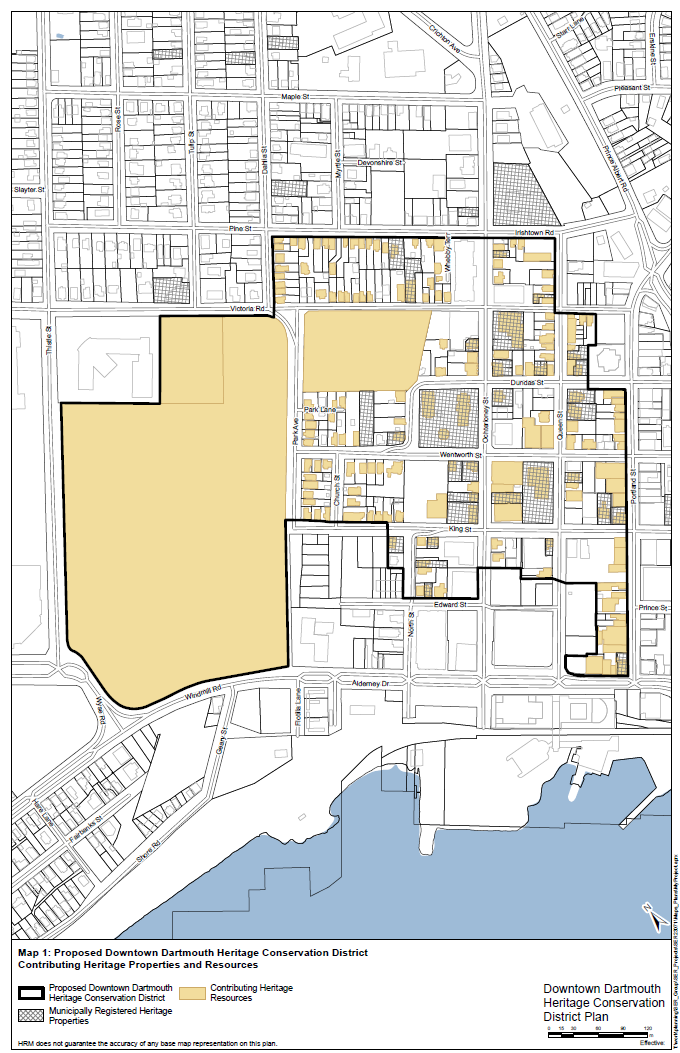 Proposed Boundaries of the Downtown Dartmouth HCD
How was the proposed boundary determined?
The proposed downtown Dartmouth HCD Plan boundary was based on the original grid of the Dartmouth town plot. This was laid out by the surveyor general in 1750 and again in 1786. Victorian era suburbs, and, potentially, a portion of the Dartmouth Common are also being considered. The boundary may change based on input during the engagement process.
What are the general objectives of the Heritage Conservation District Plan and By-law?
The general objectives of a Heritage Conservation District include:
How long will the planning process take?
The project is expected to take approximately 12 to 18 months and is anticipated to be completed by summer 2026. The planning phase is expected to commence in late 2025 with a public information meeting and community pop-ups. This will allow residents an opportunity to learn more and provide feedback.
What does this mean for my registered heritage property within the HCD?
If your property is already municipally registered, minor changes will occur once the HCD is in place. Residents will continue to have access to all existing benefits for registered heritage property owners. For more information, visit our website.
The financial incentives program for exterior conservation efforts may be updated during the planning process.
For properties located within the Heritage Conservation District, a certificate of appropriateness is required for certain projects in accordance with the Heritage Property Act. The implementation of a HCD also removes Section 18 of the Heritage Property Act. This means that any demolition of registered or contributing heritage resources requires approval by both the Heritage Advisory Committee and Halifax Regional Council.
What does this mean for my unregistered property within the HCD?
The Heritage Conservation District plan and By-law will identify buildings, structures and open spaces as either ‘contributing’ or ‘non-contributing’ to the heritage value of downtown Dartmouth. This is based on thorough research and analysis by municipal staff. More policies and regulations will apply to contributing heritage resources than non-contributing resources. A certificate of appropriateness is usually required for all new construction, exterior changes and demolitions involving contributing heritage resources within the district. For non-contributing resources, a certificate of appropriateness is generally not required. Any new construction must follow the design guidelines established in the HCD By-law to ensure compatibility with the district’s heritage character. It is important to note that the design guidelines apply only to the exterior of properties.
What will happen once the plan and by-law in effect?
Once the plan and by-law are adopted, the Dartmouth Heritage Conservation District will be officially established. A clear framework to guide all future planning, development and changes within Downtown Dartmouth will be in place. Residents can expect:
How can the public participate in the planning process?
Feedback from residents is an important step in the future of the Downtown Dartmouth HCD plan and By-law. There will be opportunities throughout fall 2025 to get involved and share your ideas. This includes surveys, community pop-up events and more. Residents are encouraged to stay up to date on the latest project updates on our website. You can also subscribe to keep directly informed about ongoing project updates.